
Products · CAAS
Taiwan's only Cooling-as-a-Service: the mobile cooling container
No plant room, water and power only, cooling about 6 weeks after ex-works. Buy or lease, and we are accountable for operating efficiency.
Who it is for
- 200–1,200 RT cooling / heating loads
- AI labs and R&D facilities
- Industrial sites with highly variable loads
- Short-term (3–5 year) cooling or heating needs
Why a container
No plant room
Provide water and power only, saving land and floor space.
Controllable schedule
Factory assembly in parallel with site works; cooling about 6 weeks after ex-works.
Mobile and reusable
Containers back each other up, scale easily and have high reuse value.
Maintenance without downtime
Low failure rates, and servicing does not interrupt cooling.
High-efficiency cooling
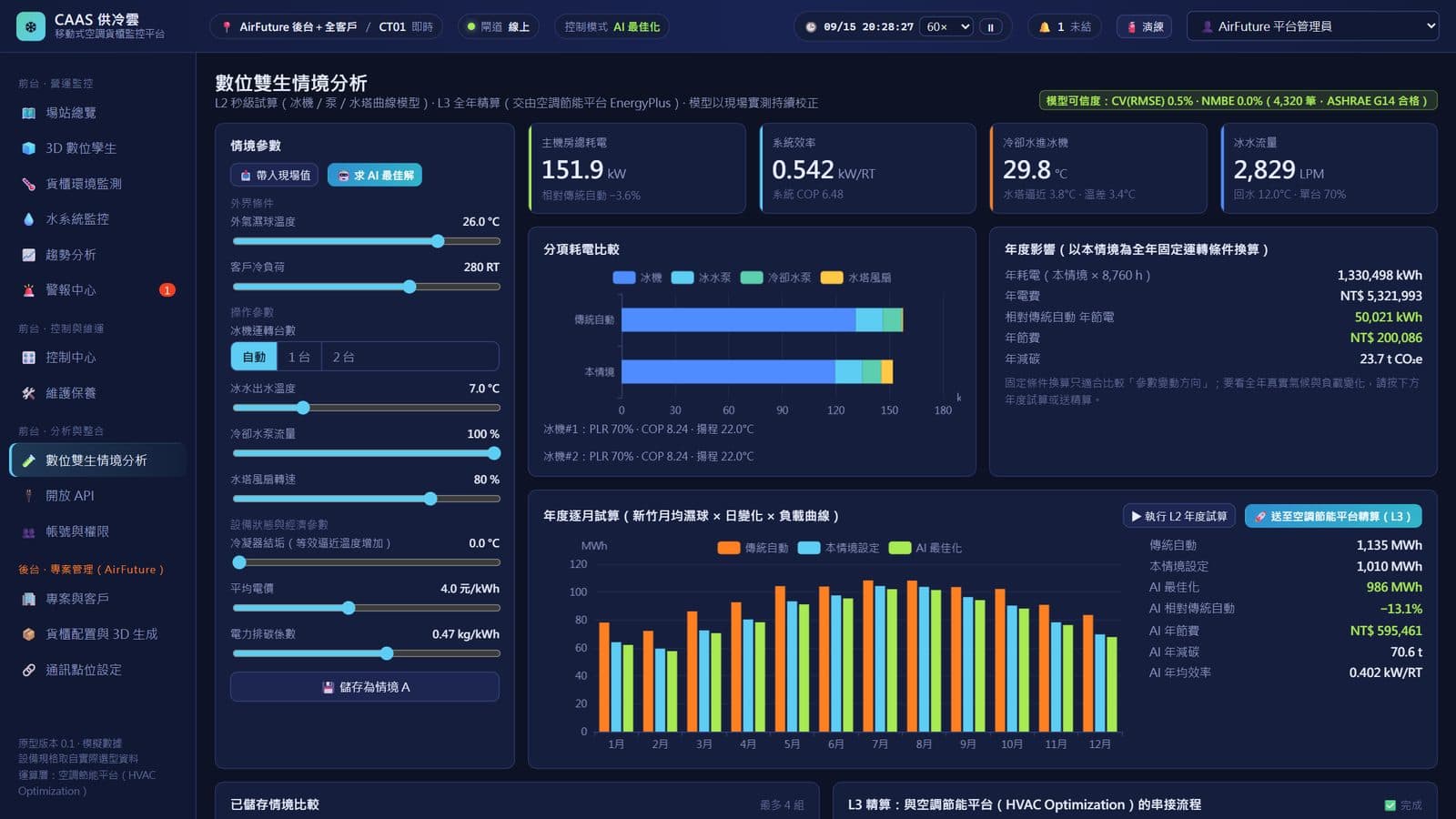
Magnetic-bearing models IPLV 11.05–11.67; AI annual simulation saves 13.1%*.
Efficiency is our responsibility
We take on operating-efficiency responsibility; leases include an O&M SLA.
Chiller specifications
York YMSC series; 250–400 RT are magnetic-bearing models.
| Model | kW/RT | COP | IPLV |
|---|---|---|---|
| York YMSC 200RT | 0.512 | 6.87 | 11.36 |
| York YMSC 250RT | 0.522 | 6.74 | 11.05 |
| York YMSC 300RT | 0.549 | 6.40 | 11.22 |
| York YMSC 350RT | 0.517 | 6.80 | 11.49 |
| York YMSC 400RT | 0.526 | 6.69 | 11.67 |
Manufacturer selection data; IPLV is the integrated part-load value. Current maximum 400 RT per container; projects above 800 RT are planned with multiple containers in parallel.
Container types
20' standard
Smaller loads and space-constrained sites.
40' high-cube
Main configuration. Example: 200 RT × 2.
45' high-cube
13.56 × 2.35 × 2.70 m, 26 t; optional rooftop PV 12 × 550 W (11–13 MWh/yr).
Example: 40' container × 200 RT × 2
- 400 RT
- Installed capacity
- 266 kW
- Full-load input
- 3φ 380V / 450A
- Recommended supply
- 129 points
- Communication points
Turnkey scope
- 1Design & equipment selection
- 2Piping works
- 3Secondary power distribution
- 4HVAC control system
- 5Meters / sensors / valves
- 6Ongoing maintenance
Cooling Cloud
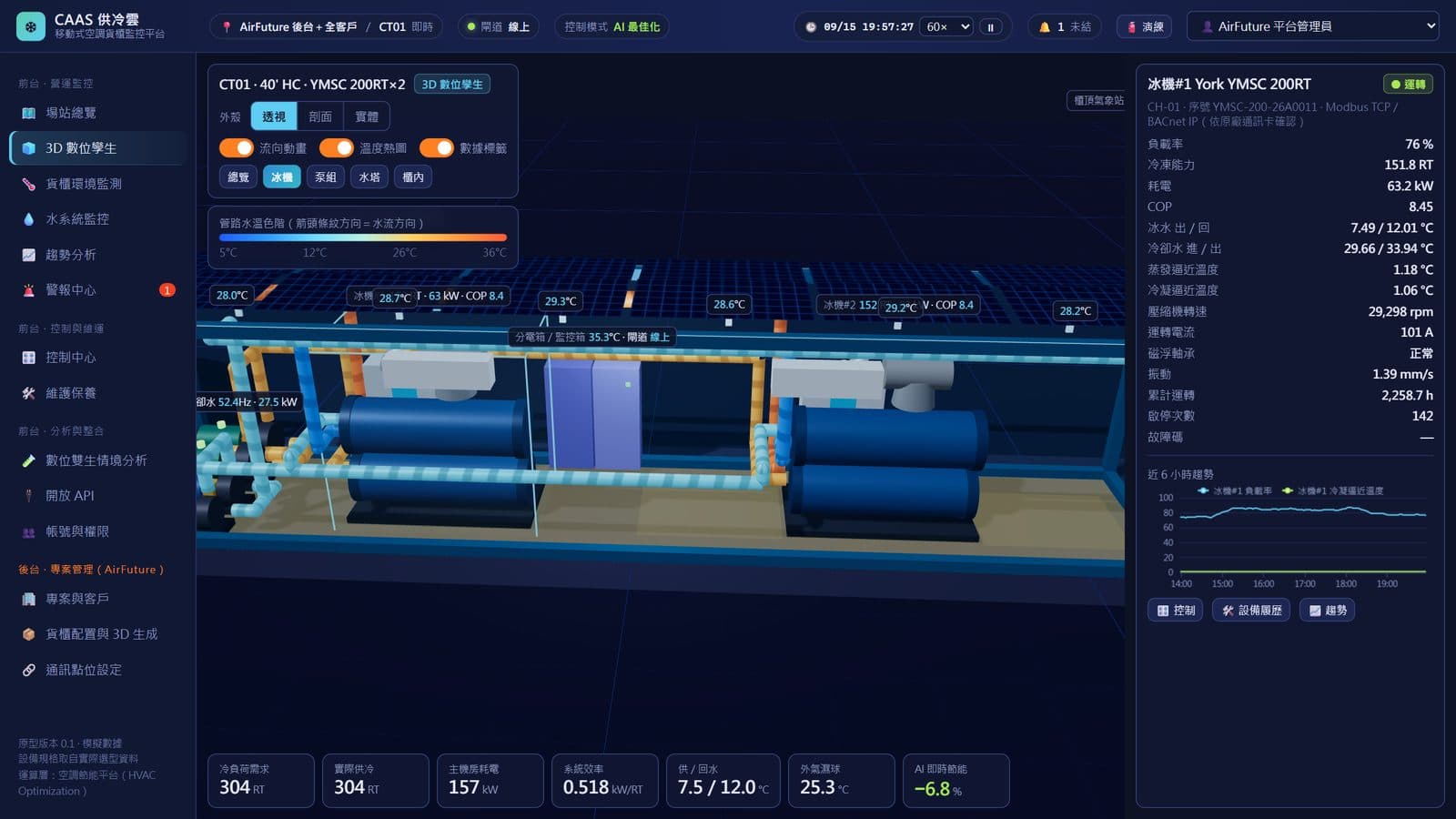
CAAS cooling cloud
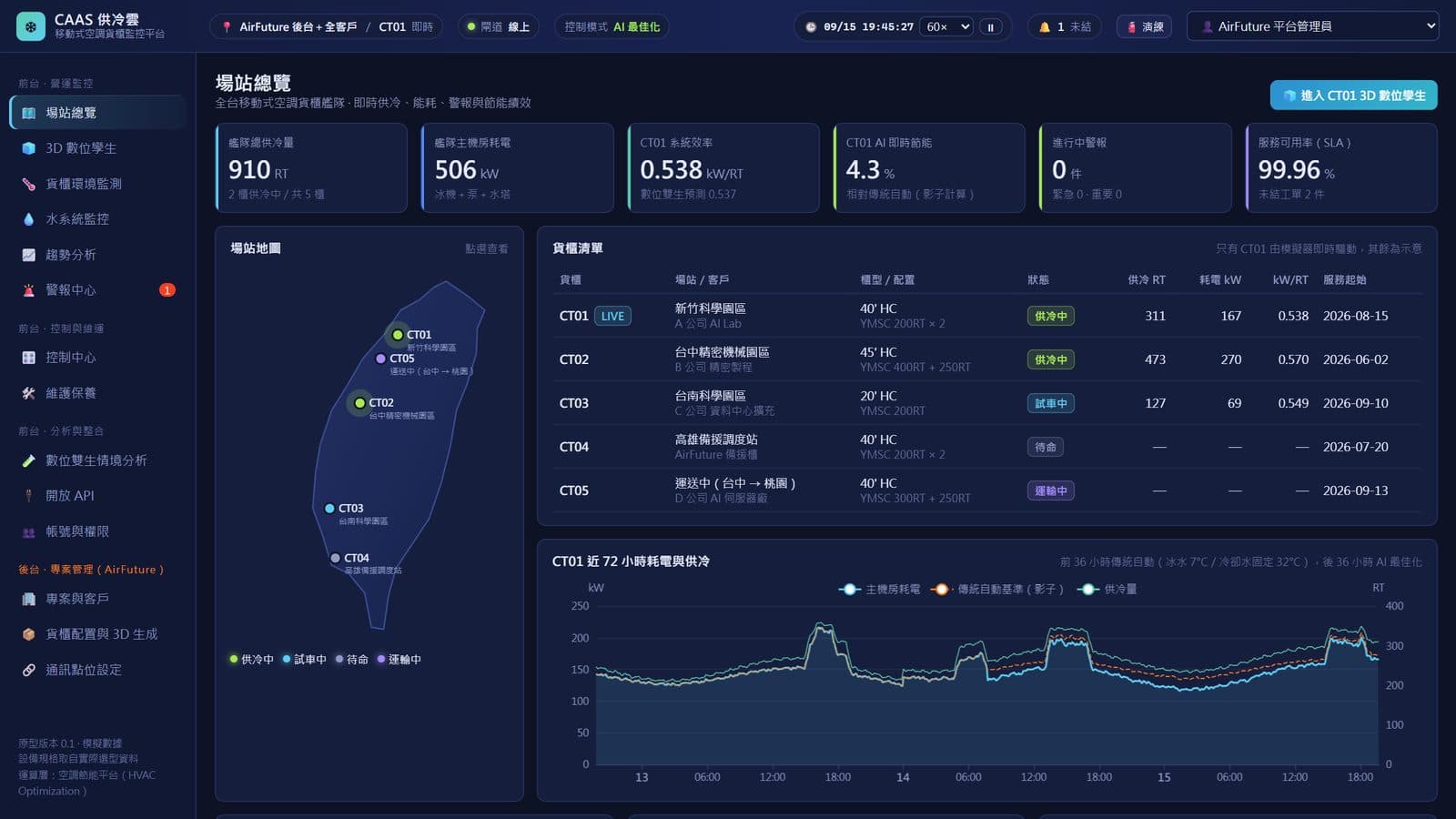
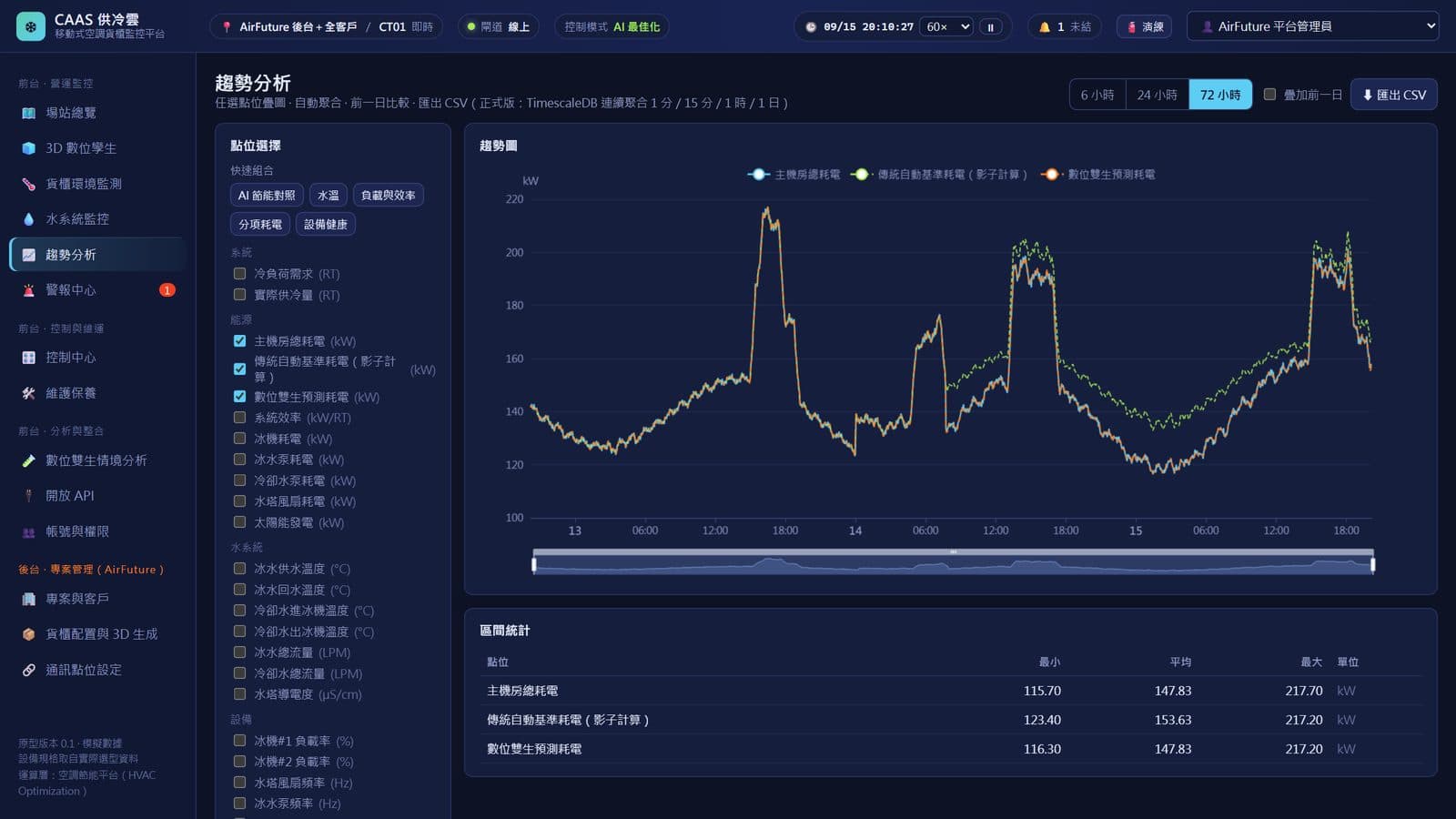
Every container connects to the cooling cloud: fleet management across sites, AI against a shadow baseline, four-level alarms and a QR service history that travels with the container.
- Multi-site fleet management
- AI vs shadow baseline
- Four-level alarms
- QR service history
- Modbus TCP / BACnet output
- Open API
IEC 62443 architecture, outbound-only gateway, mTLS + MFA; the edge keeps running when the cloud is offline.
Commercial models (combinable)
Choose by capex preference and contract term; actual terms follow assessment.
Purchase
One-off equipment payment, asset owned by the client; AirFuture’s responsibility ends at handover plus manufacturer warranty.
Lease
5–10 year annual lease: capacity fee plus variable fee. Lease starts on the date of successful three-party commissioning.
Subscription
Annual fee for monitoring, operations and maintenance.
Shared savings
Savings shared after M&V verification.
Under a lease the container is excluded from the main contractor’s scope, avoiding management mark-ups and ownership disputes.
Timeline
About 31 weeks (roughly 7 months) from contract to cooling, about 33 weeks including M&V baseline and AI shadow mode; the critical path is the chiller lead time of about 4 months. Final schedule depends on model and manufacturer confirmation.
- W0
Contract
Confirm capacity, interface matrix and power conditions.
- W21
Chiller delivered
Critical path
Chiller factory lead time is about 4 months (~17 weeks); container conversion, control panels and site piping / power proceed in parallel.
- W25
Ex-works
Factory assembly complete; cooling about 6 weeks after ex-works.
- W31
Cooling on
Three-party commissioning; lease starts here.
- W33
M&V baseline + AI shadow mode
Baseline established; AI runs in shadow mode first.
*Efficiency is York YMSC manufacturer selection data; 250–400 RT are magnetic-bearing models. 13.1% is a CAAS prototype annual simulation (Hsinchu climate, 280 RT average), not a guarantee. Actual results depend on site conditions.