
AirFuture
Building energy, engineered
with data and AI
We combine building design, information systems and sustainability scoring into fast, verifiable analysis and recommendations. AI-driven data engineering lets us iterate designs and retrofit plans quickly, so new and existing sites end up healthier, more efficient and better value.
Your Best Sustainable Cooling/Heating Environment Design Partner.
- AirCore engine: hourly annual simulation
- EEWH · BERS · LEBR in one model
- IPMVP M&V
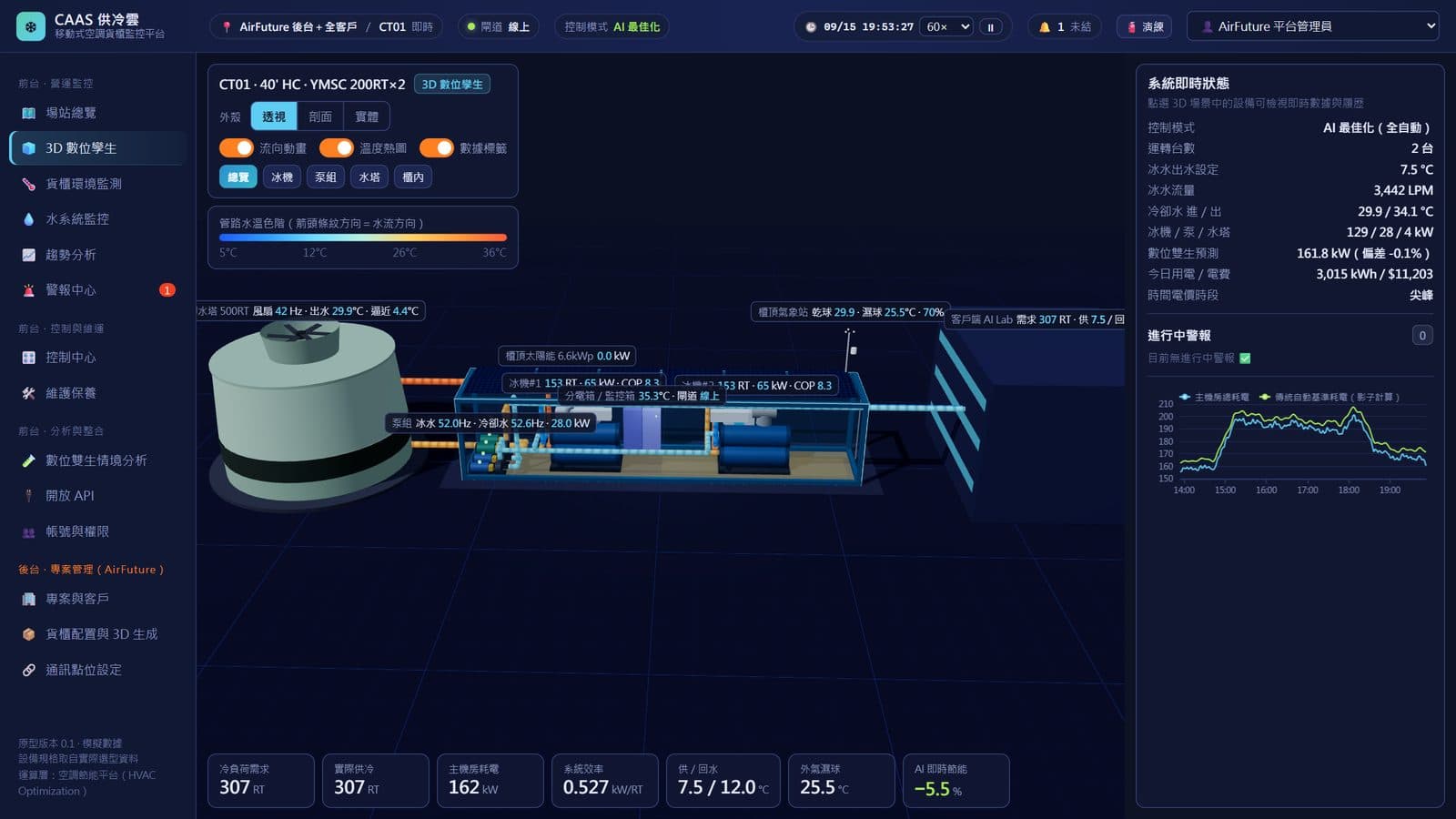
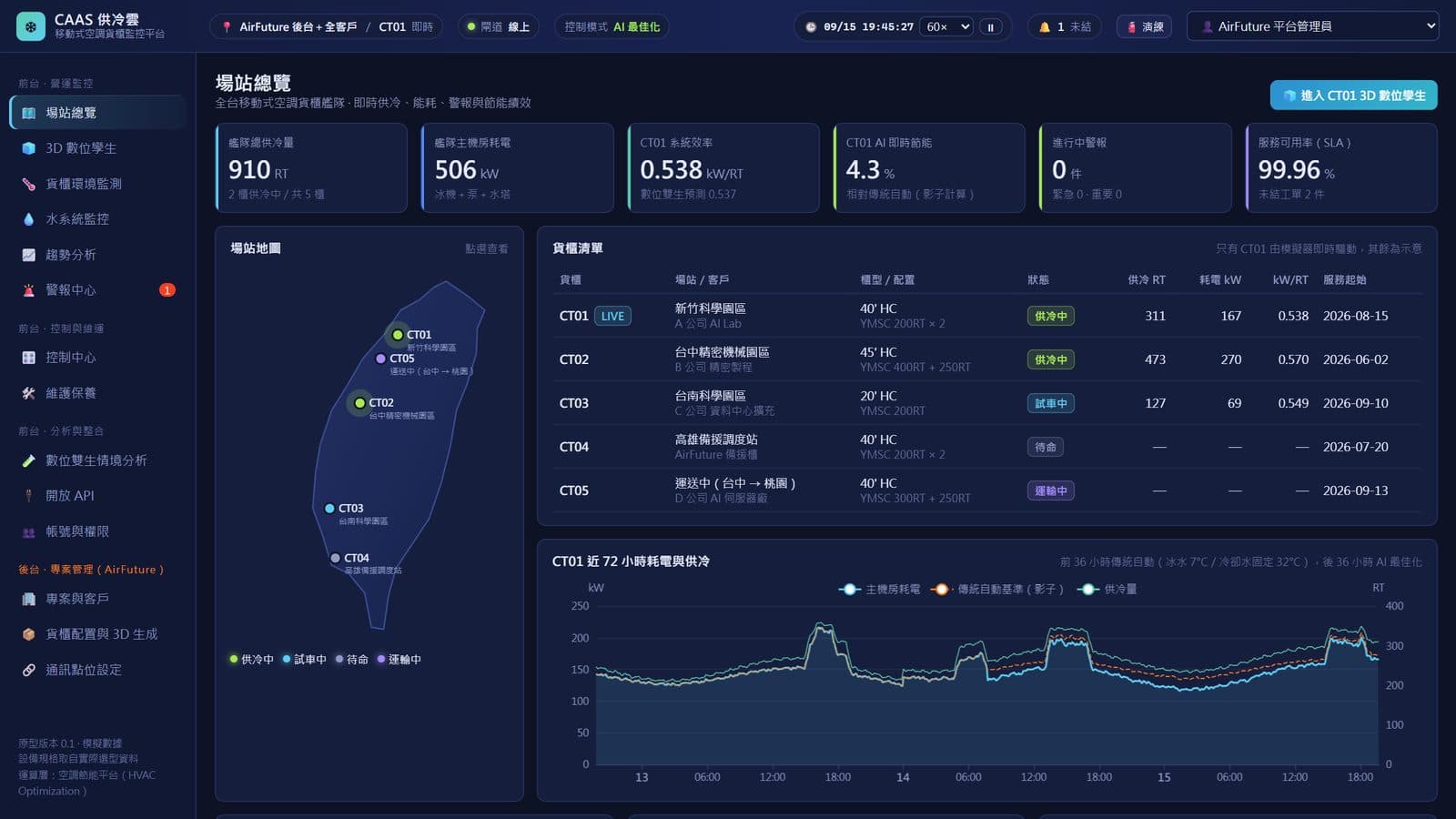
- CAAS mobile cooling containers
AirCore engine
8,760 h
hourly annual simulation
M&V
3% ± 8%
savings with uncertainty
At a glance
Your situation, our approach
Four common starting points, and how AirFuture turns each into a number you can decide on.
Your situation
Energy grades are now a permit and acceptance requirement; from July 2026 public new builds must reach Grade 1 or 1+.
What AirFuture does
Annual simulation on our AirCore engine compares options at design stage, with EEWH / BERS / LEBR calculated in parallel.
What you get
Know your grade before submission and avoid rework after the design is frozen.
Services & Applications
One platform across the building lifecycle
From design and construction to operation, the same data on the same platform. Engage us for a single item or the whole journey.
One platform, one dataset. Design information is never lost, and operating data feeds the next design.
Products
Taiwan's only Cooling-as-a-Service: the mobile cooling container
No plant room. Connect water and power only. Buy or lease, and we take responsibility for operating efficiency. Built for 200–1,200 RT, variable loads and 3–5 year cooling or heating needs.
- Cooling / heating load
- 200–1,200 RT
- Ex-works to cooling
- ~6 weeks
- Magnetic-bearing efficiency*
- IPLV 11.05–11.67
*York YMSC manufacturer selection data (250–400 RT magnetic-bearing models); actual results depend on site conditions.
Explore CAAS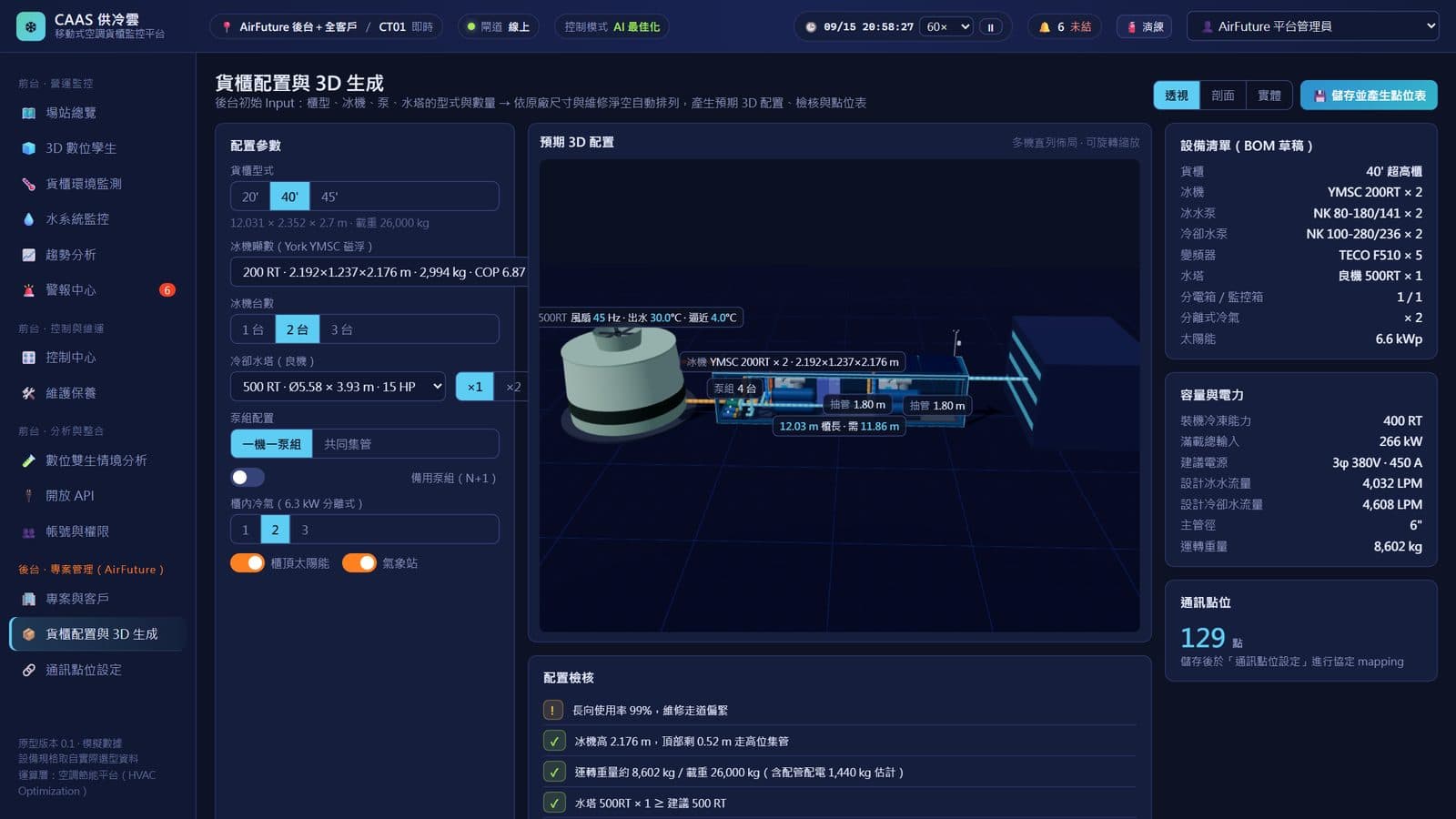

Who We Are
Domain knowledge and information technology, in one team
Our members hold licences and certifications including HVAC & refrigeration professional engineer, ISO 14064 / 14067 lead verifier, AI application planner and net-zero carbon planner, with careers at leading international HVAC companies, engineering consultancies, architecture firms and accounting firms.
- HVAC & Refrigeration PE
- ISO 14064 / 14067 Lead Verifier
- AI Application Planner
- Net-Zero Carbon Planner
What you get
An analysis you can hold us to
AirCore computing engine
Our in-house building energy engine: 8,760-hour dynamic annual simulation, not a spreadsheet estimate.
Every saving carries its cost
What you save and what you pay are calculated together. No inflated numbers.
Assumptions disclosed
Your inputs are listed as given. We never invent figures for clients.
Traceable software quality
935 automated tests, 131 API endpoints; zero severe errors in full-year model runs.
Based on AirFuture platform validation records and demonstration cases (Sept 2026); actual results depend on site conditions.
Trusted By
Clients & Partners
- Jie Cheng Architecture Group
Projects
Selected work

Hsinchu retail-and-residential new build | RP-BERSn Grade 1 assessment
Residential energy grade assessed with the RP-BERSn method at design stage, alongside EEWH HVAC energy-saving calculations, so the architecture group knew its grade and feasible strategies before submission.
Ice storage demo: 180 RT mall, annual simulation
It saves money, not energy. Annual simulation on our AirCore engine compares ice-storage dispatch strategies priced with Taipower three-tier tariffs.
Data centre demo: 400 kW IT load, air to liquid cooling
8,760-hour simulation comparing an all-air baseline with a D2C liquid-cooling architecture, quantifying PUE and cooling energy.
How we work
Every step has a deliverable
- 01
Site diagnosis
2–4 weeks
Nameplates, drawings, BMS data and site measurements combined to find whether, where and how much.
- 02
Simulation & options
3–6 weeks
Baseline and improvement cases simulated on AirCore, with tariffs, payback, NPV / IRR and carbon.
- 03
Implementation
By scope
Control strategies go live, equipment works or CAAS containers arrive; existing BMS connected via Modbus / BACnet.
- 04
M&V & tracking
Quarterly / annual
IPMVP methods quantify savings and uncertainty to support guarantees and shared savings.